
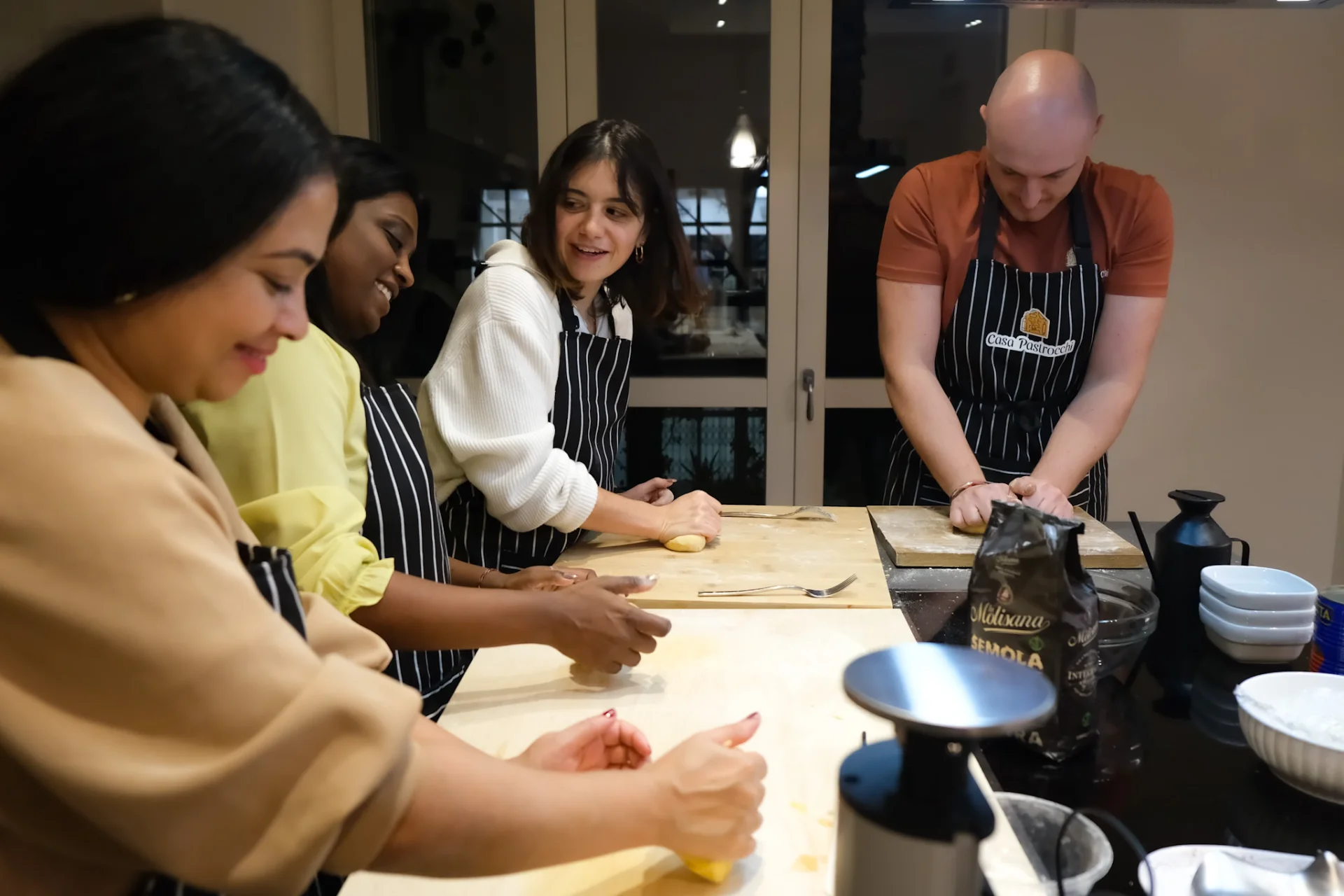
Ciao, I am Niccolò. As an Italian Chef specialized in handmade pasta, I open the doors of my home in Milan every day to travelers from all over the world who want to experience true Italian cooking. When guests arrive in our kitchen at Casa Pastrocchi, they often ask me for the ultimate secret to our cuisine. The truth is that authentic Italian food is not about complexity. It is about slowing down, honoring tradition, and using your hands to create something beautiful from almost nothing.
If you want to learn how to make pasta from scratch, you do not need a professional kitchen. You just need a desire to learn, a touch of curiosity, and a bit of love. In this guide, I will walk you through the entire ritual of pasta making, just as my grandma Silvana taught me when I was a little boy.
The Essential Ingredients for Your Making Pasta from Scratch Recipe
The magic of our culinary tradition relies on minimal, high quality elements. To create a silky and elastic dough, you only need two simple ingredients.
Here is what you need to prepare your making pasta from scratch recipe for two people
- 200 grams or about one and two thirds cups of type 00 flour. In the United States, a high quality all purpose flour works perfectly as a substitute.
- Two fresh, organic, medium sized eggs weighing about 60 grams each.
Choosing quality eggs will make your dough shine with a golden color and guarantee a silky texture. Flour is the soul of the dish, while the egg is the beating heart.
The Ritual of Kneading and Resting
Preparing the dough is a meditative act. It connects you with the present moment and forces you to feel and listen to the ingredients.
Creating the Flour Fountain
The flour fountain is the most iconic gesture of fresh pasta. You do not need bowls or whisks. Everything happens directly on the wooden work surface.
Follow these movements step by step
- Pour the flour onto your clean wooden board and shape it into a mound.
- Create a wide crater in the middle using your fingers, making sure the edges are high enough to hold the eggs.
- Break the eggs directly into the well and begin whisking them gently with a fork.
- Slowly pull in a little flour from the inner edge of the crater until the mixture thickens.
- Switch to your hands, pushing the dough away from you with the heel of your palm, folding it back, and rotating it.
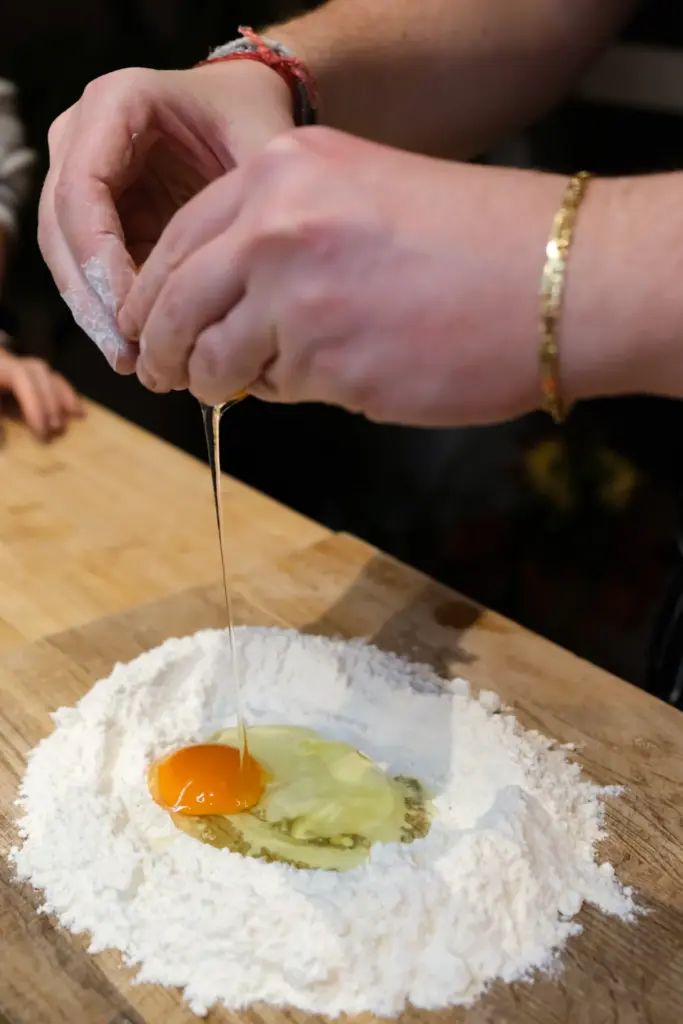
You must knead for about ten minutes until the dough becomes smooth, elastic, and no longer sticky.
Why the Dough Needs to Rest
Once your dough ball is perfectly smooth, you cannot roll it out immediately. You must wrap it in plastic wrap or cover it with a damp kitchen towel and let it rest for at least thirty minutes at room temperature. This crucial step allows the gluten to relax, making the dough much easier to roll and shape later without shrinking.
Mastering Fresh Pasta Without a Machine
Many beginners believe they need expensive equipment to succeed. However, making fresh pasta without a machine is the most authentic and deeply satisfying way to learn. This is exactly how Italian nonnas have done it for generations.
All you need is a long, smooth wooden rolling pin. If you do not have one in your kitchen, a clean, smooth glass wine bottle will do the trick perfectly.
Place the rested dough in the center of your lightly floured board and press it into a rough disc. Position the rolling pin across the center and apply even pressure as you roll away from you, then back toward you. Remember to rotate the dough frequently to maintain a round shape and ensure an even thickness. You will know it is ready when the sheet becomes translucent enough to see the grain of the wooden board underneath.
Shaping the Dough into Classic Italian Cuts
Once your sheet is rolled to about one millimeter of thickness, the real fun begins. Dust both sides lightly with flour, fold the sheet gently, and use a sharp knife to slice it into your preferred width.
Here are the traditional cuts you can create based on the width of your slices
- Tagliolini: cut at one to two millimeters, ideal for delicate broths.
- Fettuccine: cut at three to four millimeters, perfect for creamy condiments.
- Tagliatelle: cut at five millimeters, the absolute classic for a rich Bolognese sauce.
- Pappardelle: cut at up to two centimeters, excellent for hearty mushroom or wild game ragù.
Why a Hands On Class is the Fastest Way to Build Confidence
Reading a recipe is a wonderful starting point, but pasta making is an art made of feeling, touch, and intuition. Your hands need to understand the exact elasticity of the dough, the moisture of the eggs, and the right pressure to apply on the rolling pin. Mistakes will happen, perhaps the dough will be too dry or you might tear the sheet, and that is perfectly fine. Every mistake is a silent teacher.
However, having an expert Chef by your side transforms those doubts into pure confidence. During our cooking classes in Milan, Francesca and I guide you through every single motion. We show you how to correct a sticky dough, how to achieve the perfect translucent sheet, and how to pair your creations with the ideal Italian wine.
Learning in a real home environment surrounded by new friends, laughter, and a glass of wine is the true essence of our culture. If you are traveling to Italy, joining our table is the most joyful and effective way to master this timeless ritual.